
Hyperactive-impulsive ADHD: Causes and symptoms

Hyperactive-impulsive ADHD can show up differently person-to-person. Find out what common symptoms you can look out for in children and adults.

Woman smiling candidly, gazing into the middle distance and covering her mouth with both hands
Alexandra Cristina Cowell
Medically reviewed by Alexandra Cristina Cowell Clinical Support

Reading time: 3 min

Uploaded on: February 9, 2026

Having too much energy doesn't necessarily mean you have ADHD. It's normal to feel overly excited or lively, like when working towards a passion or spending time with your friends.

The difference is that people with ADHD can’t control their energy as well. When they need to focus on a task, they struggle to do so. This lack of control makes ADHD a serious psychiatric condition rather than a quirky quality.

What are the symptoms of hyperactive-impulsive ADHD?

Hyperactive-impulsive ADHD can look different in everyone. Here are a few common symptoms you can look out for:

Common hyperactive-impulsive ADHD symptoms in children:
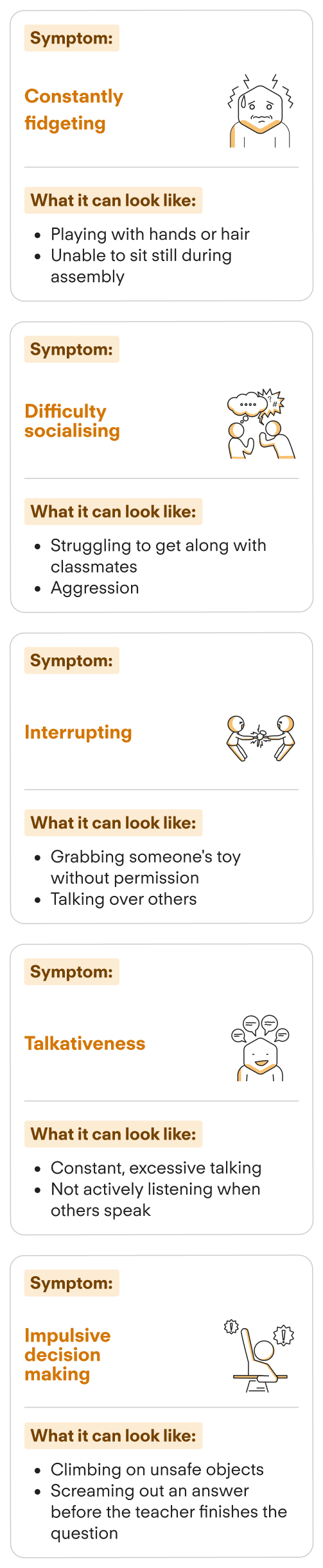
Common hyperactive-impulsive ADHD symptoms in children: Constantly fidgeting  Playing with hands or hair Unable to sit still during assembly, Difficulty socialising, Struggling to get along with classmates  Aggression, Interrupting, Grabbing someone's toy without permission Talking over others, Talkativeness, Constant, excessive talking Not actively listening when others speak, Impulsive decision making, Climbing on unsafe objects  Screaming out an answer before the teacher finishes the question

Common hyperactive-impulsive ADHD symptoms in adults:

Physical restlessness An inability to relax or sit still Constant fidgeting or pacing Mental restlessness Racing thoughts Feeling mentally “on the go” all day Difficulty slowing down your mind enough Impulsive actions Making sudden financial purchases Doing things without thinking them over properly Driving recklessly Difficulty finishing tasks Starting one chore, then impulsively jumping to another Leaving multiple tasks half-finished Difficulty with time management Arriving late to events  Struggling to organise workload Excessive Talking Talking a lot, especially when excited Cutting into people's conversation Impatience Getting irritated in queues or traffic Road rage Difficulty maintaining relationships Coming across as intrusive, intense, or aggressive Reacting emotionally too quickly Emotional Impulsivity Sudden emotional changes Difficulty calming down

What causes hyperactive-impulsive ADHD?

Like all forms of ADHD, the root causes of the hyperactive-impulsive subtype are largely genetic, with environmental factors playing a small role.[1]

While people might assume ADHD is caused by bad parenting or a lack of discipline, this isn’t true. ADHD leads to neurobiological changes that can’t be corrected by yelling or harsh discipline.

Genetic factors

Several genes have been linked to ADHD, including the DAT1, DRD5, DRD2, and COMT genes, all of which are involved in how dopamine is used.[2] Dopamine is sometimes ‘recycled’ too quickly in people with ADHD, resulting in low levels. This can lead to symptoms like difficulty focusing, lack of motivation, and impulsive behaviours.

Other genes associated with ADHD are TPH1 and VIPR2 – a gene mutation in these genes causes low levels of serotonin, which can result in symptoms like anxiety, irritability, and sleep problems.[2]

Environmental factors

Poor diet, stress, and drinking during pregnancy can increase the risk of ADHD. Research has shown that maternal stress can disrupt foetal brain development. This increases the risk of neurobiological disorders, like ADHD.[3]

Maternal smoking and alcohol have also been found to disrupt brain development, especially in the areas that are responsible for attention, memory, and emotional regulation – all functions related to ADHD.[4][5]

While post-birth factors don't necessarily cause ADHD (the genes are present from birth, but can be triggered by your early environment), a poor diet can exacerbate ADHD symptoms. A diet high in sugar and unhealthy fats can negatively impact your brain health, altering the way dopamine and serotonin are used, which makes it harder to focus and pay attention.[6]

Back to:

Overview

Read next:

Diagnosis and treatment

References:

  1. Faraone, S. V., & Larsson, H. (2019). Genetics of attention deficit hyperactivity disorder. Molecular Psychiatry, 24(4), 562-575.
  2. Prasad, S., & Kumminimana, R. (2025). Attention-deficit/hyperactivity disorder: Insights, advances and challenges in research and practice. Advances in Psychiatry and Neurology, 34(3), 196.
  3. Okano, L., et al. (2019). Maternal psychosocial stress and children’s ADHD diagnosis: a prospective birth cohort study. Journal of Psychosomatic Obstetrics & Gynecology, 40(3), 217–225.
  4. Huang, L., et al. (2017). Maternal Smoking and Attention-Deficit/Hyperactivity Disorder in Offspring: A Meta-analysis. Pediatrics, 141(1), p.e20172465.
  5. Pagnin, D., Zamboni Grecco, M.L. and Furtado, E.F. (2019). Prenatal alcohol use as a risk for attention-deficit/hyperactivity disorder. European Archives of Psychiatry and Clinical Neuroscience, 269(6), pp.681–687.
  6. Del-Ponte, B., et al. (2019). Dietary patterns and attention deficit/hyperactivity disorder (ADHD): A systematic review and meta-analysis. Journal of Affective Disorders, 252, 160-173.

Reading time: 3 min

Uploaded on: February 9, 2026

Dr Daniel
Medically reviewed by Alexandra Cristina Cowell Clinical Support Registered with GMC (00001) February 9, 2026 Meet Alexandra Cristina Cowell

focused logo
Written by Focused Content Team
Last updated on May 15, 2026
How we source info.

See other guides in this category: Getting knowledge

Browse our related guides below. Can't find what you're looking for? Let us know.

insight-1
Getting knowledge

Inattentive ADHD: An overview

All about the ‘quieter’ type of ADHD, inattentive ADHD. Find out about what causes it, its common symptoms, and how it can be managed.

insight-1
Getting knowledge

Hyperactive-impulsive ADHD: An overview

Although uncommon, hyperactive-impulsive ADHD, is less difficult to identify, because its symptoms are more obvious. Discover how (un)common it is, what causes it, and how it’s diagnosed and treated.

insight-1
Getting knowledge

ADHD & Ulcerative Colitis: The Overview

A guide exploring the potential link between ADHD and ulcerative colitis.

insight-1
Getting knowledge

ADHD and insomnia: A complex relationship

Understand the relationship between ADHD and insomnia and learn how you can manage both conditions.

insight-1
Getting knowledge

ADHD and the menstrual cycle

Understand how ADHD is affected by the menstrual cycle.

insight-1
Getting knowledge

ADHD & Pregnancy: An Overview

Understand how to navigate ADHD during pregnancy and how it might affect you

insight-1
Getting knowledge

ADHD & Menopause: An overview

More than 9 in 10 women report that symptoms like memory issues, distractibility, and emotional overwhelm worsen during perimenopause and menopause. Find out how hormone changes can influence your ADHD, and how to manage ADHD and menopause with medication, lifestyle changes, and self-compassion.

insight-1
Getting knowledge

ADHD and injury risk: What’s the connection?

Read how having ADHD increases your chances of getting injured and how to reduce your risk of injury.

insight-1
Getting knowledge

ADHD and oral health: A connection you might not know

This page explores the connection between ADHD and oral health, showing how challenges associated with ADHD can increase the risk of dental health issues.

insight-1
Getting knowledge

Understanding ADHD symptoms

Understand ADHD core symptoms like inattention, impulsivity, and hyperactivity. Learn how they differ by age and gender, and what conditions ADHD can co-occur with.

insight-1
Getting knowledge

Survey results: How does ADHD affect us in our jobs?

Read the full results of our ADHD in the workplace survey, including how long it took people to tell their employer about the condition, and how it had affected their performance.

insight-1
Getting knowledge

Why we’ve increased the price of our assessments

All the details about our price increase from £249 to £289, including what’s changed and what improvements we’ve made.

insight-1
Getting knowledge

A guide to managing ADHD and diabetes

A guide to outline the ways in which ADHD can make diabetes management harder, the connection, and some ways to make managing each condition easier.

insight-1
Getting knowledge

ADHD, anxiety, and depression

ADHD, anxiety and depression are often linked, and genetics play a key role—but there’s more to the story. Here’s what’s known so far and the treatment options available.

insight-1
Getting knowledge

ADHD & allergies

Allergies and ADHD frequently co-exist, with inflammation playing a key role in their connection. Other factors like diet, sleep, and genetics may also contribute.

insight-1
Getting knowledge

ADHD and OCD: How they overlap

You can have ADHD and OCD at the same time, making symptoms harder to manage. Find out how they’re connected, how they’re diagnosed, and where to get support.